Hi,
It would be very helpful to have the finger numbers (fingering) indicated on the lead sheets. This is one of the things that beginners struggle with.
Thanks!
Frederick
Hi,
It would be very helpful to have the finger numbers (fingering) indicated on the lead sheets. This is one of the things that beginners struggle with.
Thanks!
Frederick
Welcome to the PianoGroove community and thanks for this suggestion.
We don’t include the fingering on lead sheets, but we can add the fingering to some of our beginner PDF notation documents which I think would be useful for you.
Coincidentally, I have just finished notating some beginner PDF files - a handful are attached below - and I think it would be better to add the fingerings to these documents:
“Fly Me To The Moon” - A Section Beginner Notation.pdf (20.0 KB)
“My Foolish Heart” - A Section Beginner Notation.pdf (20.9 KB)
“Over the Rainbow” - A Section Beginner Notation.pdf (21.4 KB)
These PDFs have been added to the lessons in our “Lead Sheet Fundamentals Learning Path”. There are 27 of these beginner PDFs in total which cover the 9 jazz standards included in this learning path.
Each PDF covers an 8-bar section of the tune (A Section, B Section, etc…) to make them laser focused and easy-to-follow.
Please let me know what you think to adding the fingering to these documents.
On a related note, I don’t think I have ever seen a jazz lead sheet with fingerings.
This is because the fingering can change depending on how we play the melody (especially when adding ornamentations and embellishments) and perhaps more importantly, the type of chord voicings we play will often change the fingerings of the melody notes.
For this reason I wouldn’t recommend adding fingering numbers to a lead sheet, as the lead sheet layout is designed to be minimal in information so that it can be freely interpreted.
However, I do appreciate that it would be helpful to have the fingerings on the beginner documents above which cover 3-note spread voicings. We currently have these PDFs for the following tunes:
Just to confirm, do you only want the right hand melody fingering? Or also the 2-handed fingering for the 3-note voicings section? I think we should do both.
For the triad and 7th chord sections I don’t think fingering is necessary as we would never use these root position voicings in performance - they are just included for education purposes to help students visualise the foundations of the harmony.
Cheers,
Hayden
Hi Hayden,
Thanks a lot for updating the lead sheets! Let’s try 2 or 3 lead sheets with the fingerings and see if it helps. Both hands.
Cheers,
Frederick
Hi, I am completely in favor of adding the fingering to ALL the ones you listed. I am right now musing over the fingering for Moon River beginner lesson!
Thanks!
Hey @frederick-campbell and @Nivaldo
Rodger that - thanks for the feedback.
I will add the fingerings to these documents and re-upload them in this thread for your feedback.
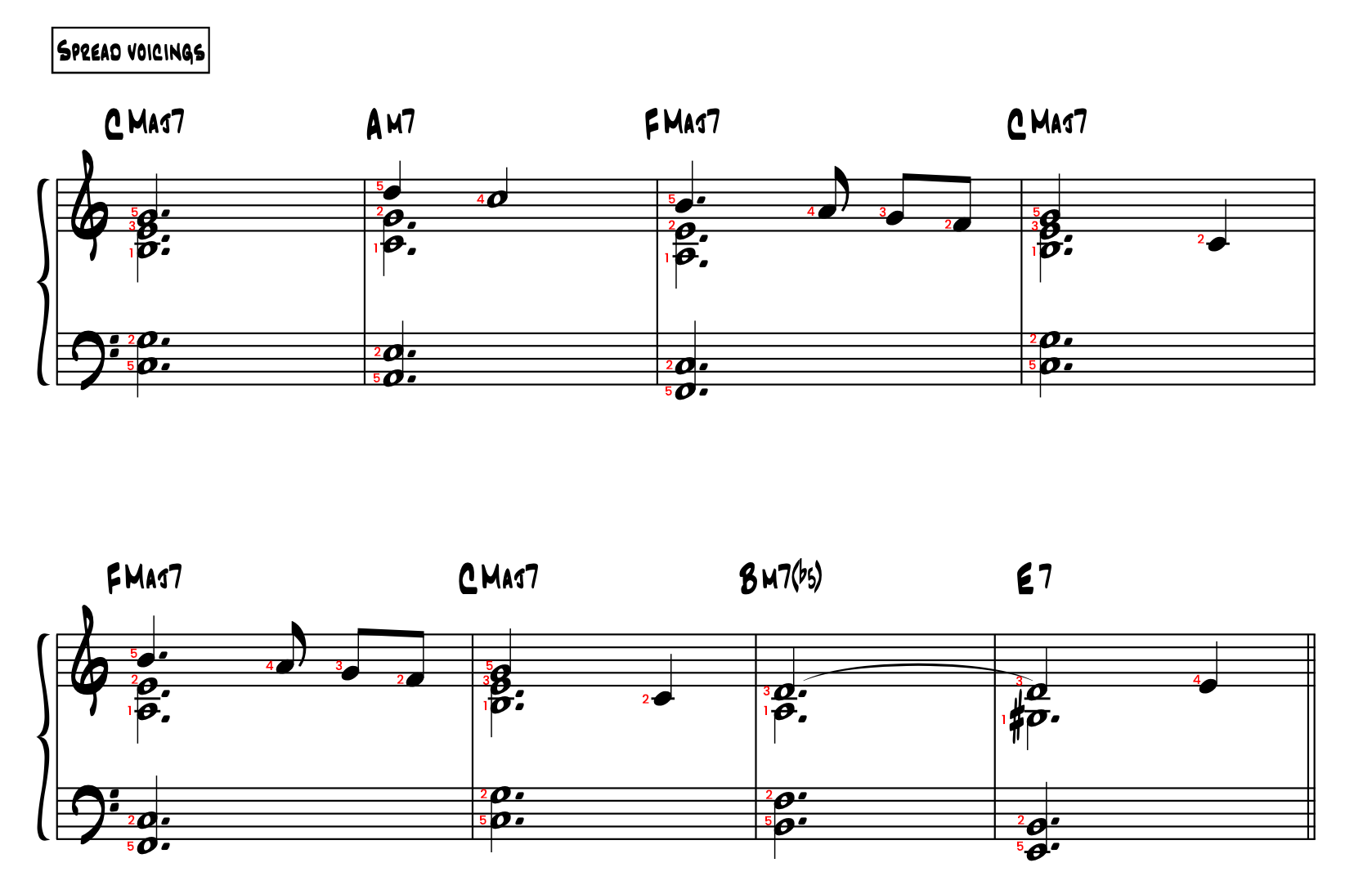
To confirm, we will only do this for the 2-handed notation of spread voicings such as the below example for Moon River. I have added the fingerings in red:
Please confirm you are both happy with this style of fingerings and I will do this for all 27 PDF files in the Lead Sheet Fundamentals Learning Path.
Cheers,
Hayden
Wonderful, Hayden. I am more than happy…this is a great reference for us beginners. I really appreciate your dedication!
Hi Hayden,
Yes, this would be of great help. Please add to all 27 PDF files.
Greatly appreciated!
Cheers,
Frederick
Yes, got it guys.
I have just sent an email to our transcriber who created these PDF files.
I have asked him to add the fingerings in the “spread voicings” section for all 25 PDF files.
His turnaround time is usually pretty quick. I’ll post an update here when I hear back from him.
Thanks for suggesting these improvements… I’m sure it will also help other beginner students too. If you have any other suggestions to improve the lessons or PDF files don’t hesitate to let me know 

Talk soon!
Hayden
Hi @Nivaldo and @frederick-campbell 
Our transcriber replied to me with the following information:
My concern is there are lot of different ways to finger these passages - I was looking at the example you provided and I would naturally play this very differently.
In my original email I asked him to add his recommended fingerings and his concern was:
I’m just worried about entering the fingering I would use normally (I have big hands) and then have to do a lot of edits and changes on the back end. Thoughts?
This highlights an issue with adding fingerings (especially for jazz transcriptions and improvised vocabulary).
The issue is that we all have different sized hands, and so what is possible and comfortable for some students might not be possible for others. Also as our transcriber mentioned he has big hands and so he would naturally finger passages differently to someone with smaller hands.
In addition, we all come from different musical backgrounds. For example, some students may have had classical training where they have been trained to follow specific fingering rules and frameworks.
I studied some classical piano in my youth, but I’m largely self-taught with jazz piano, as many jazz musicians are, and so there really isn’t a ‘one-size-fits-all’ with regards to fingering.
In summary, I will still add the fingerings (my personal fingerings) to these documents, but at the same time we’ll keep the original, fingering-free versions available for download, so students who prefer to find their own fingerings (or adapt things freely) still have that flexibility.
I just want to stress that if my suggested fingerings ever feels unnatural, or if you personally prefer a different fingering… that’s totally fine, and in fact I encourage that.
In my opinion, an important element of learning jazz, blues, and improvised piano styles is identifying fingerings and approaches that feel comfortable for our hands and support our individual playing style.
Hayden, your response makes total sense. Yesterday I lived exactly through the experience of your transcriber…the fingering suggestions were in certain places very different than what I was using and felt comfortable with. But it is still a good reference for beginners…the LH use of fingers 2 and 5, as opposed to 1 and 5, freeing the thumb for additional use later is an insight that would have escaped me. Thanks for all your attention to this…I am starting to realize that choice of fingerings is an integral part of one’s jazz arrangements…would that be fair to say?
Hey @Nivaldo and @frederick-campbell
Here are the first 3 files with the fingerings:
Moon River - Suggested Fingerings.pdf (710.3 KB)
Sometimes when playing ballads I change my fingering whilst the note is held down. For example I play the melody note with my thumb, index finger, or 3rd finger, and then switch it to my 5th finger whilst the note is still held down.
It’s difficult to write this movement with finger numbers so I omitted those movements from the fingering in the charts. If something seems unusual or difficult to finger, please reference the video files where you can see exactly how I’m playing those passages.
I will finish the other 6 jazz standards asap.
Yes some fingering choices might seem unusual when there are only 2 notes in the left hand such as the root and 5th.
However, in our more advanced lessons on the same tunes the left hand will often play 3 notes and so keeping the thumb free gives us more options.
My pleasure, Nivaldo.
Yes I would say that many jazz and blues players have fingering preferences/habits which are related to the style(s) that they play.
Thelonious Monk is a great example of a musician who had very unorthodox and unconventional fingering techniques, but one could argue that it’s exactly that which made his sound and his playing so distinctive and unique.
Anyhow, I hope the fingering charts above are helpful to get you started and I will finish the other files as soon as possible. I will post them in this thread when they are done.
Any questions or issues with the PDFs just let me know.
Indeed, I have been studying your playing of sections A and B of Moon River…lots of interesting nuances/differences across the different times you play the same sections…it’s an experience all on its own.
Thank you for all that you do for us!!
I think fingerings are pretty important for beginners. I am just starting out with piano and I have been taking lessons for a couple months. I am coming from a classical background so I want to see how jazzers think about hand positions.
Hi @Hayden,
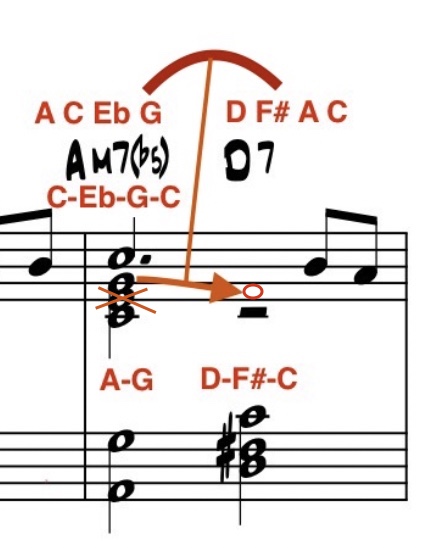
On Section B of My Foolish Heart, specifically bar 12th, I see myself dropping the Eb chordal tone in Am7(b5) so that my RH is hitting “only” C-G-C. For my RH, hitting both the Eb and G at this stage is a in-between fingers stretcher that has been difficult. Since I am dropping the 5th but keeping the 7h the resulting sound is not bad.
The reason for this digression is that I am wondering if you keep a “bag” of fingering alternatives when encountering difficult hand configurations. Since you mentioned in your last seminar that you were not yet sure which of your choices you were going to pick, would a seminar on fingering strategies be a good idea?
Hi @Nivaldo
Great question!
I have recorded a quick video for you below on the B Section of “My Foolish Heart”.
In short, one of the reasons to keep the note “Eb” in the right hand over A-7b5 is that when we move to D7, the note “Eb” becomes the b9 of D7. This is implied in minor 251s where the V7 chord often contains the b9 as it’s part of the harmony.
Moving the “Eb” into the left hand over the A-7b5 sounds nice as you correctly point out. However, from a voice-leading standpoint it’s perhaps better to keep it in the right hand so that we can keep that note over the D7 to add some extra colour and tension.
I explain more in this video:
The golden rules that I follow are:
Play the root with the left hand pinky
Play the melody with the right hand pinky
Fill in the chord tones (3rds and 7ths) somewhere in between. Usually we only have 2 or 3 possible options of how to voice the 3rds and 7ths, so try them all and see which one sounds best.
If desired we can add additional tones such as extensions (9,11,13) or alterations (b9,#9,#11,b13) and these will typically be placed in the right hand when playing spread voicings.
The melody of each song/jazz standard is different and often the melody note will inform my fingering and voicing choices. We can most definitely use the melody note as our guide to find a suitable voicing.
For example if we have a minor chord with the 5th, 11th, or 9th in the melody, the 3 important minor voicings that we cover in our Chord Extensions course will work well:
5th in the melody over minor chord - play a So What Voicing (lesson here)
11th in the melody over minor chord - play a Kenny Barron Voicing (lesson here)
9th in the melody over minor chord - play the Herbie Hancock Voicing (lesson here)
Check out those 3 lessons where I explain how this process works.
By learning these 3 voicings in all 12 keys it will greatly speed up your ability to find suitable voicings. As I outline in the lessons the key is to analyse the scale degree of the melody note.
Yes I can host a seminar on this and walk through the process above.
What songs/jazz standards would you like me to cover?
Hey @BogusPomp
Welcome to the community area!
Fingering in jazz piano is certainly more flexible than in classical piano because we have more freedom to interpret and arrange tunes and jazz standards.
In addition to the tips that I have shared in this thread, I recommend to learn as many jazz standards as possible and with time the fingering choices for different types of voicings will become more intuitive.
I recommend new students to start with the Lead Sheet Fundamentals Learning Path which covers 9 jazz standards.
You can also find our full jazz standard lesson index here, organised by difficulty.
Above anything else, pick the songs/jazz standards that interest you most. Analyse and emulate my fingerings in the lesson but remember that fingering can often be a personal choice in jazz piano.
There are some conventions to follow such as the numbered list that I shared with Nivaldo above - and so follow the steps that I outline there if you’re ever unsure:
Play the root, play the melody, and fill in the 3rd and 7th somewhere in between.
If you have any more questions or would like additional guidance just let me know.
Goodness! @Hayden, this is a dream answer! I’m serious…to have your attention, expertise and good will is truly, truly priceless! The recording and explanations are an incredible blessing. I will be reading, re-reading and applying all your recommendations. (I’m editing my response with this addendum here: the idea of recording a video to help explain all the different nuances is genius - 8 minutes of insightful explanations accompanied by beautiful exemplifications! Please don’t ever tire of doing this  …precious…and to make this addendum a shameless abuse of your good will I here remind you of the idea of recording a video of you playing all 9 standards on a single run to serve as inspiration/learning/emulation).
The standards I will be interested in covering in the possible seminar are the ones I am learning now: My Foolish Heart, My Funny Valentine, Misty, Autumn Leaves, and Moon River. As you have said, it’s a numbers game and I’m learning as many as my mind can take.
Hi @Hayden, I want to follow up on this a bit more because it brings to the forefront a gotcha issue for me…my over-reliance on the transcripts because I have difficulties replaying the videos ad naseum until I can finally understand all you’re doing…
With that in mind you can see on the image of the transcript above that there is only a rest for the RH on D7. My strategy before introducing this topic to you is illustrated by my annotations. Get rid of the difficult Eb on the right hand but make sure to emphasize the 7th to 3rd during the “rest”. (It is an F#…my annotation is not representing that.)
Also, because I am a total newbie on music theory I was not aware of the importance of sustaining the 5th for the D7…with one added limitation that I did not realize that the Eb would influence D7 solely based on the carried resonance of the note (it is a rest in the transcript).
So, a “perfect storm” of sorts. I am renewing my efforts of focusing on the video performances no matter how my eyes and brain try to avoid it.
Thanks again for the attention
My pleasure, @Nivaldo.
Yes sure, would you like this as just a video of me playing an acoustic piano? or in the tutorial layout with the light-up keyboard?
Okay great - I will schedule a fingering seminar for later this month.
I’m not a advocate of using transcriptions. I personally never used them when learning jazz harmony.
My personal advice is to avoid them completely (although I don’t think many students follow my advice here!!) and instead focus on the voicing shapes and visualising the chord tones.
I understand this is a slow process and involves a lot of pausing, rewinding, slowing down the video etc… but I feel that this is the best way to learn jazz harmony.
The transcriptions are provided as students request them, but as you mention always be conscious of developing an over-reliance on transcriptions.
Yes please note the 7th falling to 3rd is present in the left hand (G falling to F#).
In the beginner lessons we don’t directly discuss and explore chord alterations to keep the lessons focused and accessible. To answer your previous question as to why the Eb is better voiced in the right hand, we had to dip into that theory.
Yes it is a rest in the transcription because this is a beginner lesson, so it was intentionally omitted.
We explore minor 251s and chord alterations in the following 2 courses:
These 2 courses are both in the “Essential Jazz Harmony” learning path which contains what I deem to the most important theory topics for beginner/early-intermediate jazz piano students.
My pleasure.
As I have mentioned in the past, once you have learnt 10 or so tunes, the process of choosing voicings will become much more intuitive.
You will likely forget some of the arrangements as you learn new ones, this is normal. As the years pass some tunes will stay in your repertoire, others will drop out.
For now just focus on learning as many new tunes as possible to expose yourself to lots of different harmonic situations.
Best,
Hayden
Hi @Hayden
Hhm, I just cannot make up my mind on this one. My original desire was to listen to your your renditions of the 9 standards…I have completely fallen in love with them. And when you mention an acoustic piano than that sounds like a dream. But the possibility of seeing the fingerings in detail makes this an agonizing decision. I will punt to you and what you think is the best way to leverage this request. If you decide on the former I will be thinking of a way to import this to iTunes and listen to it in my car, assuming I have your permission of course.
This is a MAJOR recalibration for me Hayden…this is arguably the biggest lesson for me to take from this interaction.
Thanks for all the links embedded in your responses…great help!!