Hi Paul,
Welcome to PianoGroove! Hayden, I’m sure, will have some good (better) advice.
I started with PG a couple of years ago as someone who was relatively new to piano, let alone, jazz piano. I found that the Foundations class gave me some fundamentals I knew were lacking. The Guide to Lead Sheets course was introduced later, but if you’re already pretty proficient then that might be the better choice. I am always exploring new ideas (right now it’s Block and Drop 2 Chords and that’s technically an advanced course), and Hayden encourages exploration of lots of techniques and concepts.
The beauty of Hayden’s teaching style is that he sets a high bar, and while not everything makes sense or is easily doable for me the first time, I am always finding new nuggets I missed or couldn’t comprehend when circle back to the Foundations or Lead Sheets courses.
It can be overwhelming (and sometimes daunting) looking at all of the great content and trying to pick and find your own path. Jazz offers so many great aspects that it’s tough to choose, but personal style comes from all of these avenues that influence learning directions.
Best wishes on your own “piano journey”.
Ron
It’s not a silly question at all - here what I recommend for you:
I recommend students to spend 50% of their practice time on the jazz standard lessons, and 50% of their practice time on the theory lessons/drills/exercises.
Jazz Standard Studies
If you have no prior experience with jazz piano I recommend to start with the Lead Sheet Fundamentals learning path - you can find that learning path here:
This learning path covers 9 jazz standards with simple yet beautiful arrangements. The goal of this learning path is to build out your repertoire of jazz standards and teach you the basic skills for harmonising lead sheets.
After joining PianoGroove you will have received a welcome email entitled “Let’s find your perfect jazz standard course” - search your inbox and you will find that email.
In that email I suggest some other jazz standard courses which are more suitable for students with previous jazz piano experience, or beginner students who want to push themselves with more advanced theory.
Theory Lessons, Drills, & Exercises
In tandem with the jazz standard courses, I recommend students to spend 50% of their practice time on the theory lessons and courses.
If you are new to jazz piano the Jazz Piano Foundations Course is the best place to start:
This course teaches the basic building blocks of jazz harmony which are major and minor scales, intervals, triads, 7th chords, and the 251 progression.
It may be that you are already familiar with this information in which case you can progress onto the next courses in the “Essential Jazz Harmony” Learning Path, you can find that here:
This PDF file contains the most important theory drills and exercises for beginner and early-intermediate jazz piano studies.
The titles in the PDF are the 4 courses that are listed in the “Essential Jazz Harmony” Learning Path above.
If you search your email inbox for “The 4 most important theory areas” you will find an email from me where I give these theory recommendations.
As @Ron_T mentioned, jazz theory is a vast topic with many different branches and avenues one could take in terms of theory and style.
The theory courses in the “Essential Jazz Harmony Learning Path” are what I personally deem to be the most important and essential theory areas for anyone who wants to play improvised piano music (jazz, blues, Brazilian, gospel, funk, Cuban etc…).
Spend roughly 50% of your time on the jazz standards, and 50% of your time on the theory lessons, and you will see rapid improvement with the PianoGroove learning method.
I hope that helps @paulbauer - and let me know i you have any further questions.
I’m also hosting a seminar next week on setting goals and creating a practice schedule, you can learn more and add it to your calendar here:
I’m on day 2 of PianoGroove and had some questions that I imagine many new members may have.
When you recommend spending roughly 50% of practice time on jazz standards and 50% on theory, does that mean working on two lessons concurrently? For example, would I do one lesson from Beginner’s Guide to Lead Sheets and one from Jazz Piano Foundations on the same day and practice concepts from both?
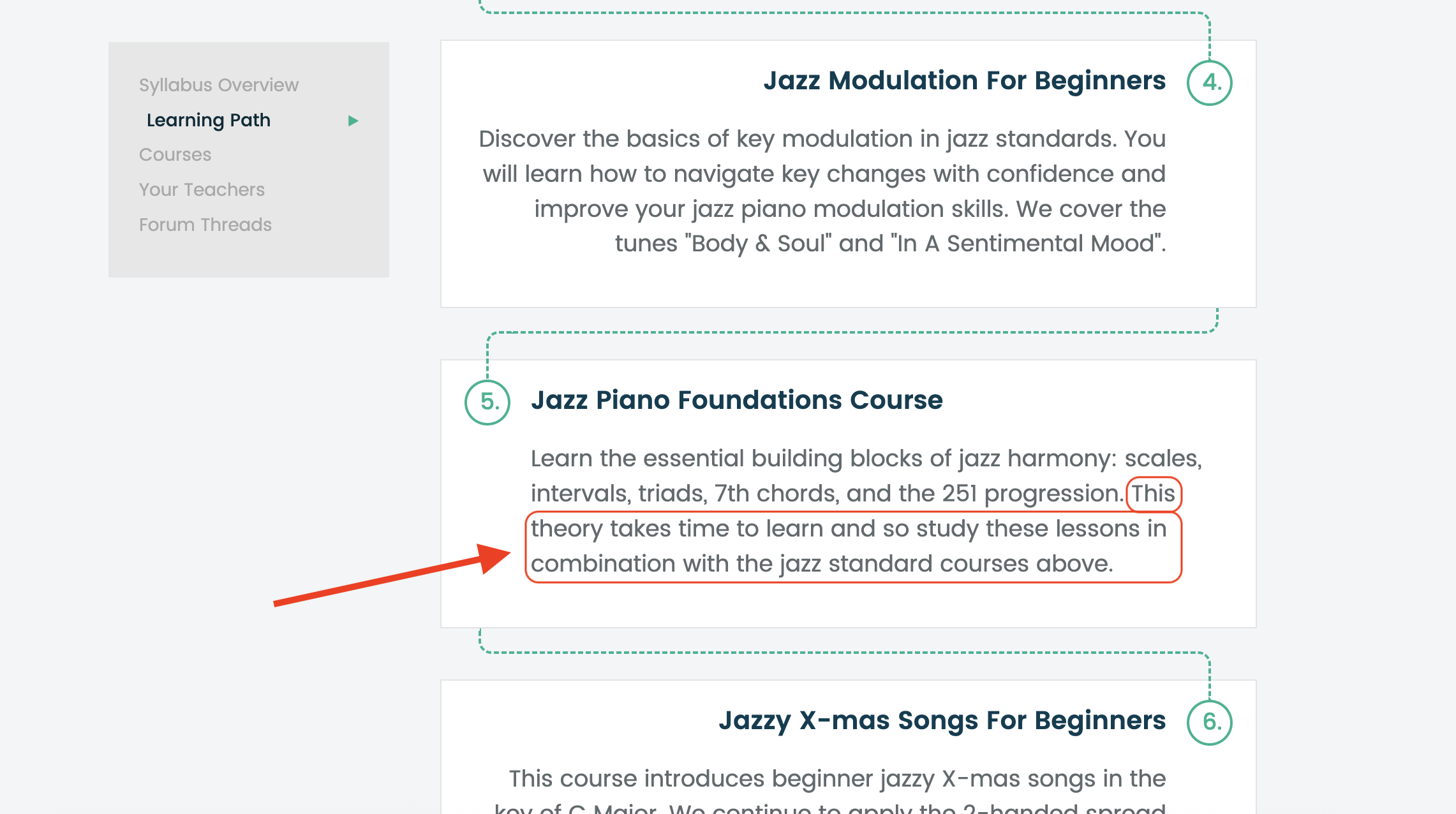
I noticed that Jazz Piano Foundations appears as the final lesson in the Lead Sheet Fundamentals learning path, which made me wonder whether the intent is to move through that path sequentially first, rather than working on Jazz Piano Foundations concurrently from the beginning.
I also registered for the Goal-Setting & Practice Planning webinar and submitted some of these questions there as well.
Separately, I’ve noticed that the website has been loading a bit slowly over the past couple of days. Each page takes several seconds to load after clicking. I’m not sure if this is a known issue or something specific to my account.
Lastly, after signing up, I only received the payment receipt and haven’t received any additional emails (nothing in my Junk folder either). Just wanted to check whether that’s expected.
Thanks so much. I’m really excited to get started.
Great questions and thanks for submitting your questions for the live seminar on Wednesday.
I have answered your questions in detail below and I will elaborate on some points during the seminar this week.
So this recommendation is based on the broad allocation of our practice time.
For example, if we have two hours to practice each day, I recommend to spend one hour on theory lessons/drills/exercises, and one hour on learning new jazz standards or revisiting/developing the ones we already know.
If we have one hour to practice, then 30 mins on theory and 30 minutes on jazz standards, etc…
Why do I recommend to split our time this way…
The main reason I recommend this 50/50 split is that learning jazz piano involves learning a lot of theory - particularly when starting out - which can be overwhelming and also monotonous.
Playing jazz standards is the more enjoyable side of learning jazz piano and so spending half of our practice time on this helps to prevent ‘theory burnout’. It also helps to build out our repertoire of tunes that we can play for ourselves or perform for others.
For many people the ‘end goal’ is to be able to play jazz standards freely and spontaneously (whether that’s solo piano or in a group setting) and so building out a repertoire of tunes is a key priority for new jazz students.
Break Down Theory Practice Time Into Smaller Chunks
I also recommend to break down theory practice into smaller ‘chunks’ where we focus on 3 or 4 specific topics or drills and revisit those drills daily.
I will explain more on this in my seminar on Wednesday, but for example, if we have 1 hour to spend on theory, we can pick 3 or 4 drills or exercises to work on in that hour.
Your time allocated to ‘theory’ might initially just be watching the lessons to understand the concepts.
All or most of the theory lessons in the beginner courses contain drills/exercises which I demonstrate at the end of the lesson, and so once you understand the underlying theory you can start to complete the drills on a daily basis.
There is no ‘one size fits all’ as everybody learns differently so it’s difficult to give you an exact formula but hopefully the above information is useful.
My recommendation for most students is to study these courses in tandem.
I tried to indicate at this in the ‘learning path’ section - please see the screenshot below - but I agree it’s not super clear. I think adding an explainer video to the top of the Learning Path would be better. Leave that with me.
I didn’t want to put the Foundations course as the first step in the Learning Path as that would suggest that one has to learn all of the scales, triads, 7ths chords, and 3-note 251 progressions before starting a jazz standard which I think would be overwhelming and intimidating for someone new to jazz theory.
My view is that it’s best to immediately get started with some jazz standards. When we can see the how the theory is applied in actual music, it helps us to understand why the theory drills and exercises are important which is a good motivator.
Please let me know if you have any further questions here.
Practicing On A Tight Schedule
I saw in one of your questions submitted to the Practice Planning Seminar that you mentioned time constraints and concerns about practicing on a tight schedule.
You might like to check out the “Essentials Practice Guide” which covers the key theory from the foundations course in a neat and tidy practice exercise:
The goal is to get through all 12 keys in around 5 minutes or so. I believe I demonstrate this in the lesson above.
You can start by trying to get through as many keys as possible in 10 or 15 minutes and take it from there. If getting through all 12 keys is difficult to start we can group them into sets of 3 of 4 keys and then alternate our practice around this. I believe I explain this in the lesson so click the link above for more information.
If this material is easy or familiar, then jump into the next theory course which is Chord Extensions, as outlined in the Essential Jazz Harmony Learning Path:
These courses can be studied on a modular basis, for example 1 day on Foundations, 1 day on Chord Extensions, and repeat.
This contains the most important theory drills for beginner and early-intermediate jazz piano studies. The titles in the PDF match the titles in the Learning Path above.
Thanks for letting me know.
I’m not aware of any issues but I will investigate this with the developer tomorrow.
My apologies I see the welcome emails were not sent to you.
I have just sent you 2 welcome emails which give recommendations on jazz standards and theory courses. Most of the email content is the same as what I have explained above.
If you check your inbox you should see that they have arrived.
I just joined PianoGroove and I love the platform! I’m a beginner piano player and, after exploring the site, I realized my heart leans 100% towards the Blues rather than Jazz for the moment.
I saw your great response with the “Beginner Jazz Piano Roadmap” PDF and the 50/50 practice split between standards and theory.
Since I want to focus exclusively on Blues, Gospel, and Boogie-Woogie, do you have a similar structured “Blues Roadmap” or a recommended step-by-step learning path for beginners? I want to make sure I take the courses in the right order without getting lost in pure jazz territory too early.
Firstly, as I’m sure you’re aware, there is a lot of variety between different blues piano styles.
For example, Chicago Blues and Boogie-Woogie are harmonically simple, especially when compared to New Orleans Blues, Gospel Blues, and some of my Slow Blues piano courses.
In my opinion, having a good understanding of beginner/early-intermediate jazz harmony is essential for playing any style of improvised music (whether that’s blues, gospel, Brazilian piano styles, Cuban piano styles, funk, neo-soul, RnB etc…)
For this reason I highly recommend to study the courses in the “Essential Jazz Harmony” learning path which you can find here:
This learning path contains 4 courses which cover the following topics:
Jazz Piano Foundations (scales, triads, 7th chords, and the 251 progression)
Chord Extensions (9ths, 11ths, and 13ths)
Rootless Harmony (how to visualise rootless voicings and rootless 251 progressions)
Altered Harmony (b9, #9, #11, #5/b13 and upper structure triads)
I’m not suggesting to study/master all of this theory before starting on the blues courses.
I’m just highlighting that this theory is very important for any musician who wants to play improvised styles of music.
Based on this, I’d suggest that you split your time, perhaps 50% on the blues courses which I outline below, and 50% on these jazz theory courses in the Essential Jazz Harmony Learning Path.
You could also split your time 75% on the blues courses, and 25% on the Essential Jazz Harmony Syllabus. That might work better for you. The most important thing is that you are not ignoring that essential jazz theory.
If you have no interest in playing jazz standards, then you can skip the jazz standard studies and just focus on the theory lessons and theory drills where you will learn the harmonic theory.
Here’s how I recommend that you approach the blues courses:
Intro To Chicago Blues - This course introduces left hand shuffle patterns, right hand comping, blues licks and riffs, and turnarounds. This course doesn’t require much harmonic knowledge, but it does require solid left hand rhythm and hand coordination.
Boogie Woogie Piano Course - this is classed as an intermediate level course mainly due to the hand coordination needed to play this style at faster tempos. The style is harmonically simple and actually quite similar to the chicago blues style but played at faster tempos.
Slow Blues Piano For Beginners - this course is taught by myself and it’s a mixed level course. Whilst it’s possible to play the slow blues with basic voicings (roots, 3rds, 5ths, and 7ths) I much prefer the sound of blues piano when we incorporate chord extensions, chord alterations, upper structure triads, and other jazz concepts. That’s my personal preference.
I recommend that you study all 3 of these courses simultaneously. When studying my slow blues piano course, you will start to encounter jazz theory from the second module onwards.
It might be that you don’t want to play this more harmonically-sophisticated style of blues piano, in which case you can focus your time on the Chicago blues and Boogie Woogie courses.
If you check out any of the New Orleans Blues and Gospel Blues courses, they also incorporate a lot of jazz theory, and so to understand and follow the lessons I feel that it’s very important to understand the jazz topics that I highlighted above.
I hope that helps Michael - if you have any follow up questions just let me know.
I have decided to follow your advice regarding my practice split. I will spend 25% of my time on the jazz foundation material, which will allow me to properly build up my theoretical foundations. To be honest, I had no idea how to approach these elements before, so this guidance is incredibly helpful. The remaining 75% will be dedicated to the blues courses.
This approach feels highly complementary and will give me a very solid baseline moving forward. Thank you so much for taking the time to provide such a detailed response; it feels like I now have a clear learning plan for the years to come.