There’s is propably no other musical phenomena more important in all western music than II V. I don’t mean that the II V appears in that form everywhere, but the phenomena that in jazz is called a II V I, shows up in all western music in different forms.
Let me explain.
If you are not familiar with II V, please go check out the following tutorial:
Firstly, we have to think of II V as one thing, not necessarily 2 different chords. We need to understand what is happening in II V I, which is:
II and V: something that clearly creates movement in music, and needs to be resolved. II already has a quality that might need to resolve, but not as strongly as when we get to V. II in music theory is called "subdominant’, and V “dominant”. In general, on an idea level, we should not separate these two, as their main purpose is just to create tension and to keep the music moving forward.
Here’s and example of how II V I sounds, and then how they sound separately when resolving to I:
II V I
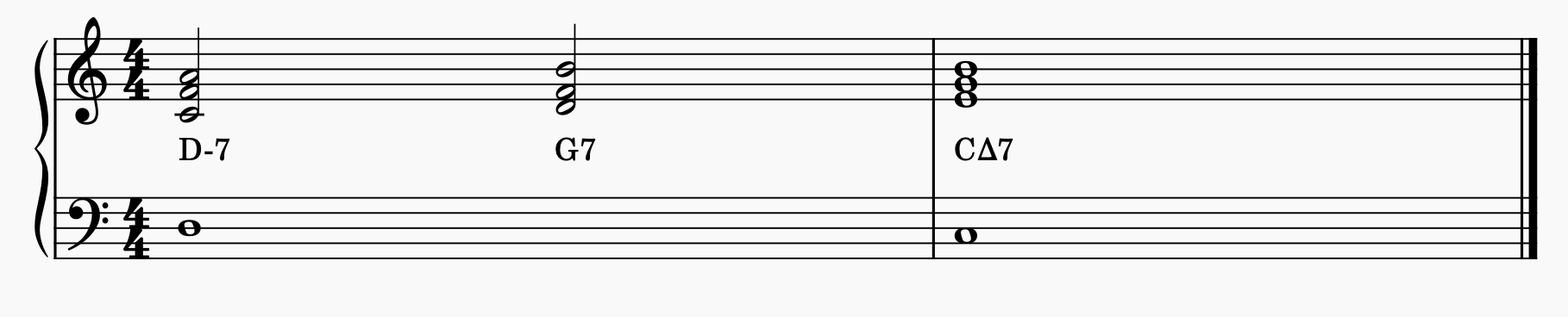
just a V I

just a II I

Like I mentioned earlier, in jazz, this musical phenomena is called II V I, however for example in classical music it’s usually referred to as IV V I, where instead the II chord we have 4th degree chord. here an example:
IV V I

As you can notice, the II and the IV chord are basically the same thing, with the basic voicings above the right hand stays the same, only bass note changes.
This is a good example of how this musical event functions the same way whether we play it with the II chord or IV chord.
And this is where we get to my main point: to me, II V is just a thing that has to move/resolve.
This goes to the simplest to the most complicated, from just V I to whatever is possible to variate/reharmonize/change over the tension.
I will show different examples of this in the part 2.