Hi Hayden, just wondering if you have any lessons on the Grip System. Or, any thoughts pro/con about the Grip System. For some reason this has been on my IG/FB feeds. Must be subliminal, LOL.
Hi @jeffhufford 
Great question!
Whilst I haven’t studied the Grip System in detail, my understanding is that it involves learning and internalising specific chord shapes (or “grips”) and understanding how they relate to different harmonic contexts, scales, and chord progressions.
From what I understand, it’s an interesting approach and there are some similarities with the way I teach harmony, chord progressions, and creating fills/runs.
For example, one chord voicing that I frequently demonstrate is a minor 11th chord built using a minor triad in the left hand and a major triad starting on the minor 7th in the right hand.
For G-11 it looks like this:
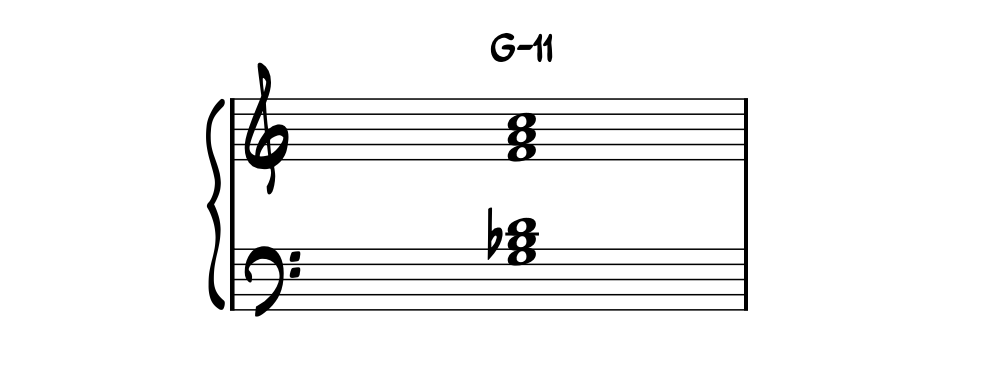
Looking at the notation above, you should be able to visualise the G- triad in the left hand, and the Fmaj triad in the right hand.
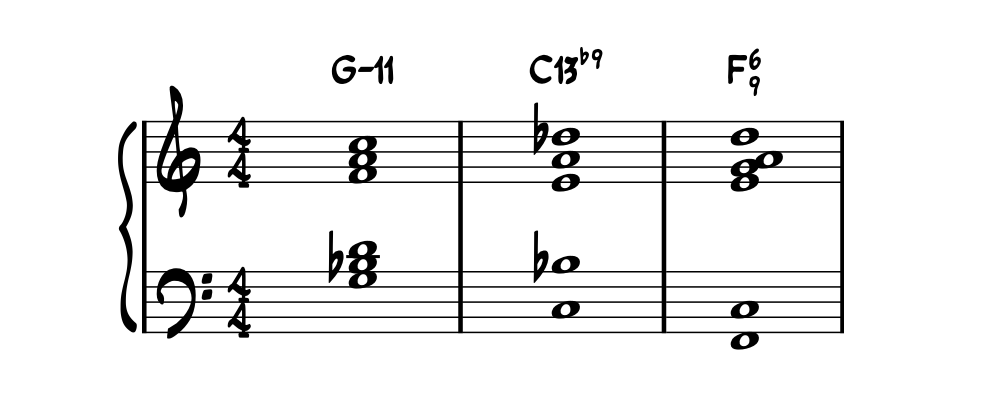
We can then move the outer notes of the F triad a half step in opposite directions to create an upper structure triad voicing for the V7 chord, giving us a 13b9 sound on the V7 chord:
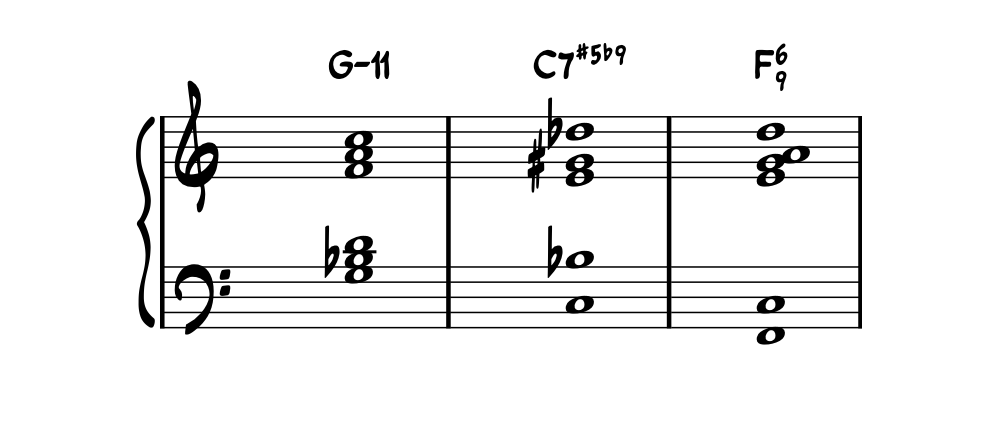
If we move the bottom 2 notes of the triad down a half step, and the top note up a half step, that creates a #5b9 sound on the V7 chord, here C7#5b9:
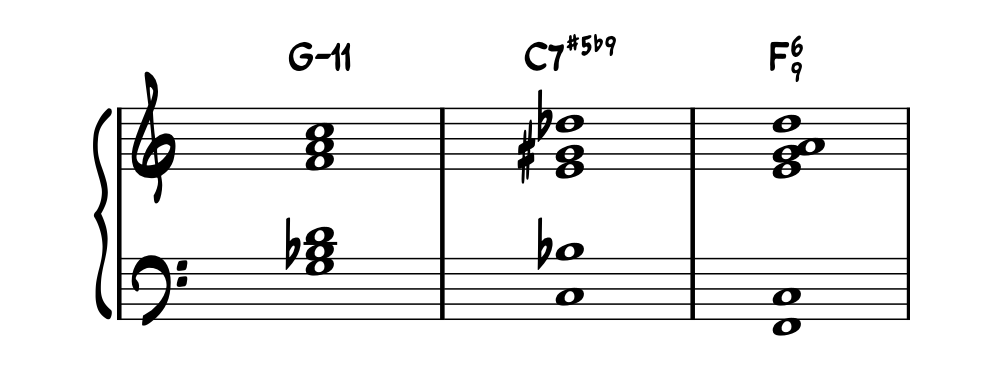
If we move the bottom 2 notes of the triad down a half step, and the top note up a minor 3rd, that creates a #5#9 sound on the V7 chord, here C7#5#9:
Also works with minor 251s
We can also apply these same movements to the minor 251 progression.
Here my left hand changes for the ii-7 chord and I play G-11b5. Instead of thinking “minor triad in my left hand”, I’m now thinking “root and b5 in my left hand”.
Notice that the right hand triad is the same, which then allows me to do same movements when moving to the V7 chord, here C7#5#9, and resolving to F-7, not Fmaj7:
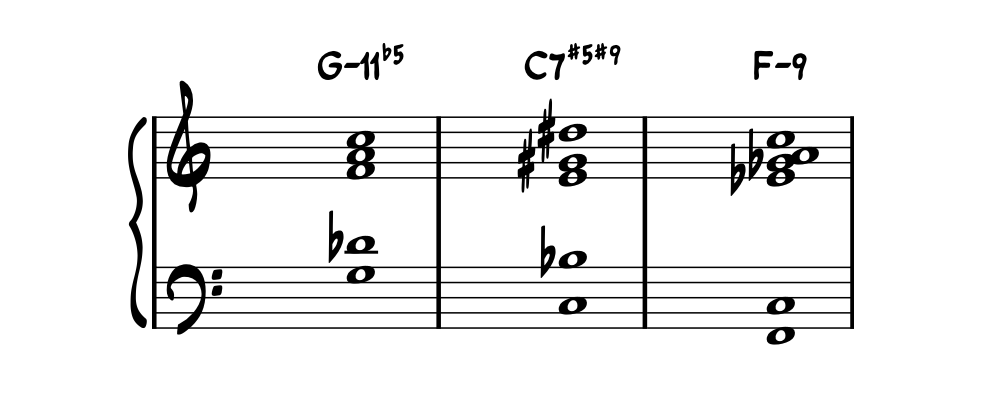
These are all good example of how we can internalise chord shapes and use small, economical movements to create sophisticated jazz harmony.
Learning the ‘starting positions’
It’s very important to learn the ‘starting position grip’ which in this case is the -11 chord voicing played with a minor triad in the left hand, and a major triad off the minor 7th.
For G-11, we would think ‘G- triad in our left hand’, and major triad off the -7th of the chord which is F so… 'Fmaj triad in our right hand.
Once we have learnt that voicing in all 12 keys and can visualise it quickly, the rest of the progression is relatively small movements that can be internalised and committed to muscle memory.
Learning shapes & understanding theory
I think there’s a lot of value in this kind of visual and physical approach.
As we become familiar with the shapes, we can recall them quickly without having to calculate or over-analyse every individual note that we are playing.
However, I do also think it’s important to understand what we’re playing and how it functions harmonically, rather than relying exclusively on memorised shapes.
Using the above example, I use the shapes and muscle memory to play these progressions freely and spontaneously without much thought, but at the same time I understand how each of those altered notes relate to the underlying dominant chord, and how that chord functions within the key.
Ultimately, I think the most effective approach combines both: developing a strong visual and physical familiarity with the keyboard, alongside a deeper understanding of harmony and voice leading.
So whilst I can’t comment on the complete Grip System from personal experience, I certainly see value in the underlying approach.
I hope that helps Jeff - if you wanted to share any examples from the Grip System I’ll happy check them out and let you know my thoughts.
Here’s a PDF file with the chord progressions that I created above:
and here is a seminar where we apply these progressions as fills and runs and I explain the movements in more detail:
Cheers,
Hayden