I found one of those jewel moments (there are so many!) between minutes 7:25 and 7:55 of this lesson:
Basically, you advance the notion that Ghost notes, like Stride, help keep the pulse of the song more explicit and, perhaps more importantly, raise interest in the performance by filling gaps during static moments in melody and harmony.
I know you have Ghost notes in almost every beginner’s lesson where you play jazz ballads. I already took notice of that and have been emulating it in several of the standards I am learning. So my question to you is: do you have any extra pointers to give me on the topic of Ghost notes…perhaps some additional practical considerations that come to mind now that I zoomed into this aspect? (I couldn’t find much in the forum when searching for ghost notes.)
Please excuse my late reply - and yes here is some additional information on ghost notes:
In this particular example, “pulse marker” might be a better description: we’re using very soft left-hand notes to outline the quarter-note pulse beneath the ballad.
It’s essentially the same thing as a ghost note in the sense that we are subtly outlining the underlying pulse or rhythm, but the difference is that here we are talking about jazz ballads.
Ghost Notes In Swing Jazz Music
“Ghost notes” are often found in swinging jazz solos and are an important component of playing with swing feel. These are notes played very softly, giving them more of a rhythmic role than a melodic one. They help maintain the swing feel and groove but their pitch may be barely discernible.
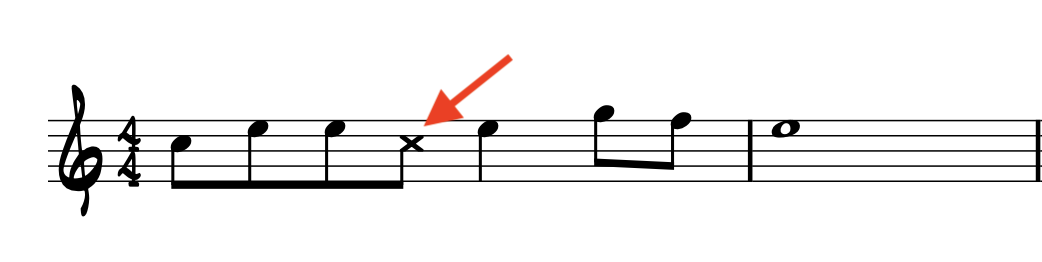
In a jazz transcription, ghost notes will often be labelled with an “x” notehead, or the notehead will be placed in brackets/parentheses.
Here’s how a ghost note can look with an “x” notehead:
If you listen to the following audio file, first I play the ghost note very softly relative to the other notes in the line. The second time, I still press the key, but so lightly that no sound comes out.
The first example illustrates the label “ghost note” in that the note is there, but it’s very faint… like a ghost.
The second example takes this a step further: I feel the note’s rhythmic placement through my hand movement, even though it isn’t audible. Even then, the physical movement of pressing the key helps me to maintain the rhythmic flow:
Ghost Notes In Samba & Funk Music
It’s also common to hear the term “ghost notes” in the context of heavily syncopated music such as Brazilian samba or funk music, where the underlying 16th note pulse is an essential component of the groove.
Here are 2 Brazilian piano lessons which explore ghost notes in the context of the groove:
To tie this back to jazz ballads and the lesson that you reference above… here we are simply outlining the quarter note pulse (1-2-3-4) in our left hand.
This can be useful to keep the feel of the jazz ballad when the melody and/or harmony rests, but it doesn’t play the same rhythmic role as in the examples and lesson links above.
In summary, it’s a device that we can use to keep the pulse or the groove when the melody and/or harmony is static.
I hope that helps and if you have any follow up questions please let me know.