I’d like to start with a bit of my musical background. I grew up in India learning Indian classical music on sitar and tabla. High school and college were rock / pop, then I moved to the US and took (European) classical lessons for a decade+. I started playing some jazz and blues from sheet music, but I had no idea what I was doing, and I knew that wasn’t how this music is supposed to be learnt. Most YouTube lessons were too basic or too advanced. A few months ago I found PianoGroove, and a couple of weeks ago I found Band-in-a-Box, and I’ve been having a lot of fun.
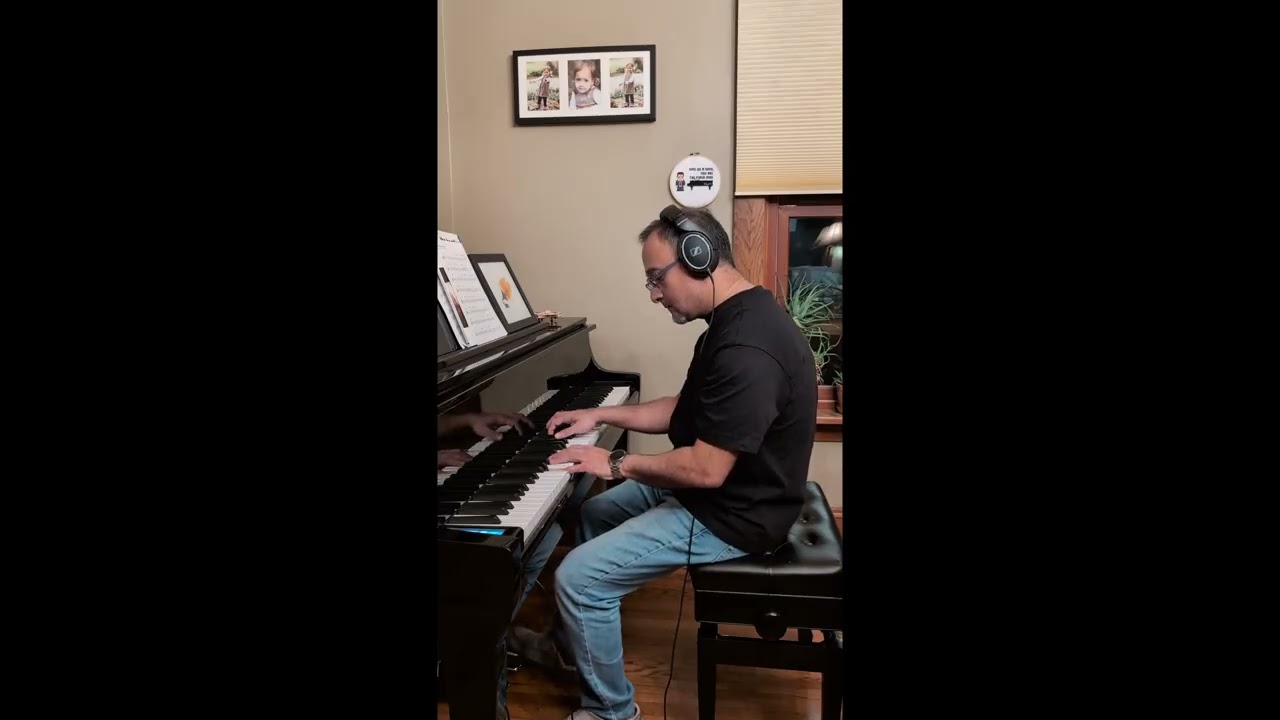
Here’s my recording of Georgia On My Mind. It’s nothing special, and I’ve played many different versions of this before. But this is the first time I’m not playing someone else’s sheet music, and I’m happy about that.
Now on to the feedback part. To me, this still sounds more like classical than jazz Here are some things that I think I should work on, I would love to hear others’ feedback.
I need to stop playing the roots that low, it’s interfering with the bass. I’ve never played in a jazz band, and I’m adding the drums and bass in a DAW, so it sounds “empty” when I’m recording the piano portion if I don’t play the root notes that way. Plus that’s how I’ve always played. Maybe playing along with iRealPro might help me change that sound?
It feels too lilting / lyrical to me, doesn’t really feel like a jazz ballad. Over pedaling? Too many notes / not enough gaps? Something more?
Firstly, I notice that you are not reading the lead sheet and so you have internalised the harmony and the chord changes which is great. That’s a very important first step to playing any jazz standard with freedom. Great job there.
Secondly, I see that you are adding melodic embellishments and making the melody you own - which is also brilliant. You have moved beyond reading the notes from a page and you’re starting to play more spontaneously. You’re off to a great start here!
Now onto some very important feedback with your backing track setup…
Backing Track Settings and Configuration:
As pianists, when playing with a backing track we generally have 2 options:
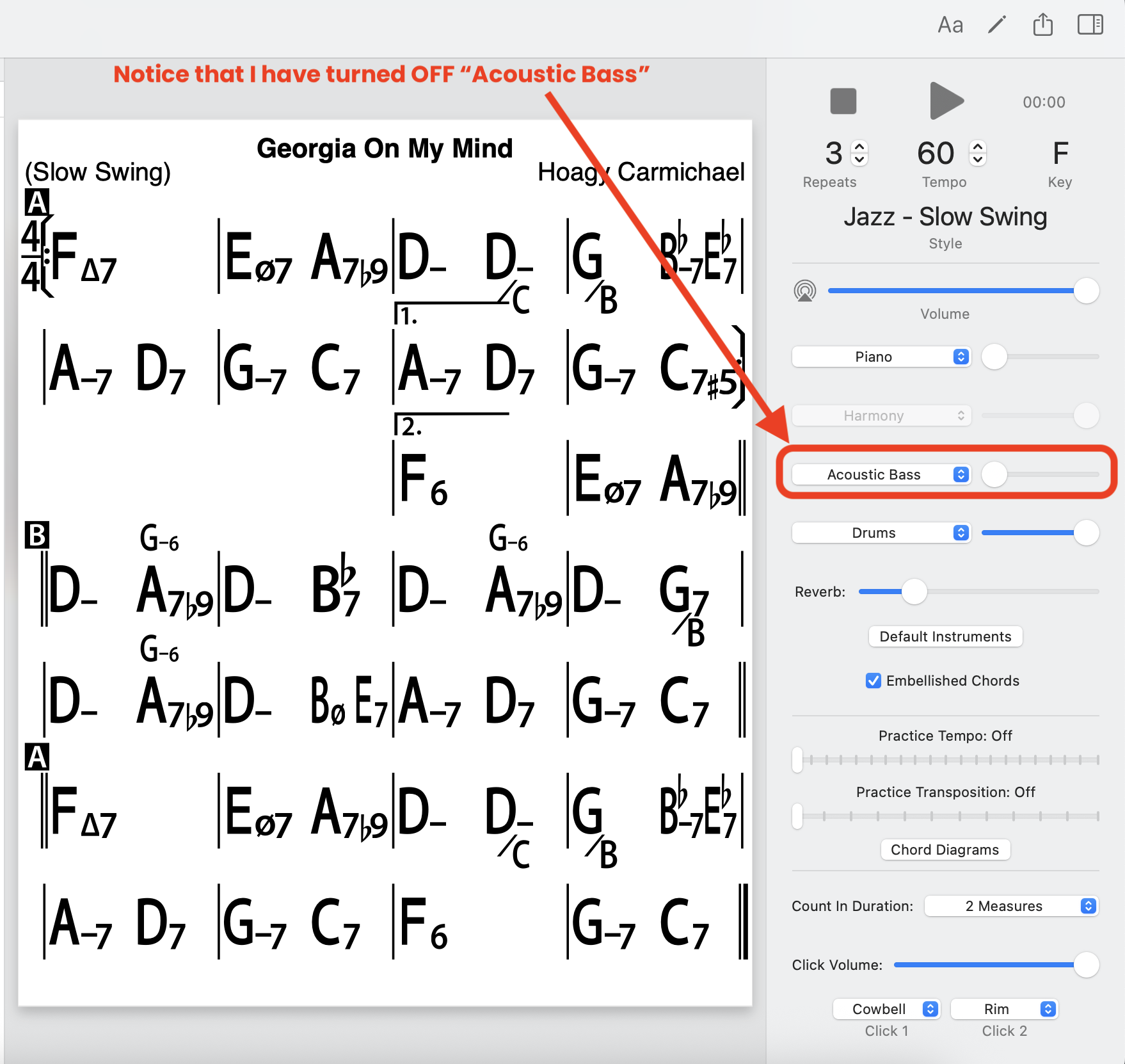
We remove the bass from the backing track and we play rooted chord voicings.
For the style that you are playing here (rooted voicings in your left hand) it’s very important that we remove the bass from the backing track.
Otherwise the bass notes/root notes of our chords will clash with the backing track, and it will sound very ‘heavy’ in the low end.
Band In A Box & iRealPro
I’m unsure how to remove the bass in Band In A Box, but I’m positive there will be a setting for it.
Using iRealPro App, you can see the slider on the right hand side which allows us to adjust the volumes of the backing track elements (drums, bass, and harmony).
This is more advanced and so first I would recommend to learn the tune solo piano without a backing track - please see my recommendations below.
Here’s what I’d recommend for you:
Firstly check out the lessons in my course “Bluesy Stride Piano For Beginners” which focus on the song “Georgia”:
This course is designed to be played without a backing track.
You will learn the following areas:
Spread Voicings (I can hear from your recording that you already understand spread voicings well and you are comfortable with the basic harmony)
Stride Left Hand - I think this will be very useful for you. When playing a stride style for ballads, our left hand is essentially the bass player, and the harmony, and this gives the right hand much more freedom to embellish the melody and to add fills and runs.
Turnaround Variations - “Georgia” is a great tune for applying turnaround variations. There is a dedicated lesson for that in the course. Here is the link.
Passing Chords - we also explore passing chords which is when we add additional chords into the song to create more harmonic interest.
Also check out this seminar where I explore fills, runs, and adding improvised touches to the song “Georgia”:
I hope that helps - check out the lessons I reference above and I think they will be a great fit for your current level.
I’m here to help if you have any further questions.
Hi Hayden, thanks a lot for such a detailed response!
It is very easy to remove the bass track from BiaB, that’s a good suggestion. But also, I’ve been playing solo piano with rooted left hand for a while, so I think trying out rootless voicings will be a good exercise for me. Thanks for sharing that link.
I’ve watched part of the beginner Georgia course, I stopped around the passing chords / reharm videos because that got too advanced for me. I’ve been trying the turnarounds, but that’s new for me as well so I didn’t try to record it. I had not found the improv workshop, thanks a lot for that link. I think that will be very helpful for me at my current level.
That will certainly make your arrangement sound less heavy and remove the bass note redundancy (in the sense that both you and the bass player are playing the bass notes).
When playing with a bass player, they will usually (but not always) play the root note of the chord when the chord changes, so if you have the bass in the backing track and you are also playing rooted voicings, it means that every chord has 2 root notes played by 2 instruments which is why it sounds heavy.
Yes that’s a very good idea if you want to play with a backing track with bass, or with an actual bass player.
We have a course on rootless voicings here:
Georgia On My Mind Trio Performance
If you check out the Georgia comping demonstration lesson below (performed by Tuomo) you will see that he does play some rooted voicings (mainly for the Fmaj7 and E-7b5) however the vast majority of his chord voicings are rootless:
When he does include the root in his voicings, it’s always played in the octave directly below middle C, and never in the lower octaves. This ties into the points I made about redundancy and sounding too heavy in the lower registers of the piano.
Essentially our goal is to ‘stay out of the bass players way’. By that I mean we don’t play in the lower registers of the piano because that is the register where the bass player is operating.
Instead our goal is fill out the harmony in the middle registers of the piano to complement and not compete with what the bass player is playing.
Yes that course is mixed-level and the difficulty level does pick up starting in module 2.
You can always swing back to those topics later.
Yes I think you will enjoy that seminar as I can see that you are already experimenting with melodic embellishment in your recording.
I also created 2 other stand-alone tutorials on Georgia which you can find below. In these lessons we explore the major and minor blues scale relationship and we look at different ways to embellish and ornament the melody:
I hope that’s helpful and keep me posted on your progress!
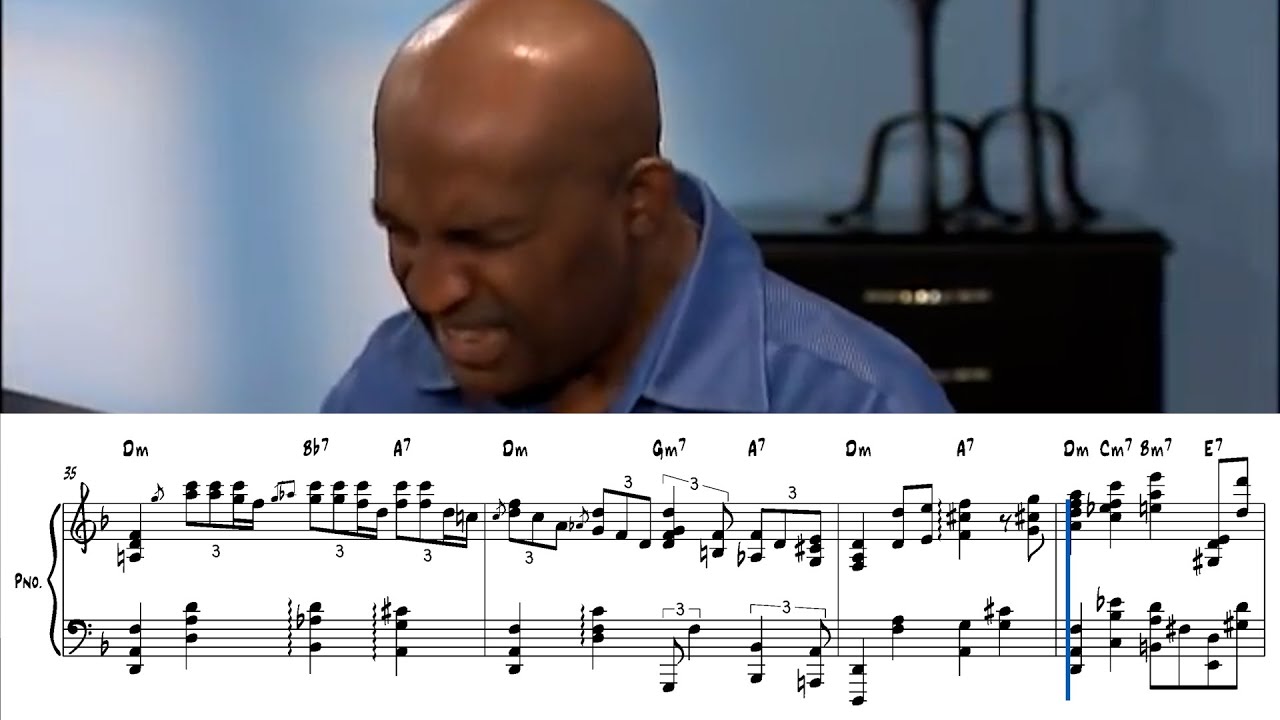
I love Georgia on my mind. You picked a fantastic tune! In addition to Hayden’s detailed response I thought I would share an inspiring version of Georgia on my mind performed by Bobby Floyd.
That was beautiful, thanks for sharing! I can kind of do fast runs like that in the context of classical music, where everything is memorized and practiced. I’m nowhere close to being able to do that while improvising. But that’s fine, one thing at a time. That version was beautiful even in the simpler passages.
Thanks a lot for these resources. I don’t know how I missed the lesson on rootless voicings, I think that’s exactly what I need right now.
 Here are some things that I think I should work on, I would love to hear others’ feedback.