Autumn Leaves Improvisation Lessons

Hi everyone :wave:

Last week’s seminar introduced my new Autumn Leaves Improvisation Course which will be ready soon. It’s currently being edited and should be ready later this week.

The seminar below is a nice introduction to the course contents. We explore the use of enclosures and approach patterns to add structure to our improvised solos.

I have added the blue highlights, notation, and chapters to make the seminar contents easier to review, check it out here:

Here are the seminar PDFs:

Here is the backing track:

Quartet Backing Track App

I highly recommend students to grab a copy of the “Quartet” backing track app.

It’s similar to iRealPro but has much more realistic instrument sounds.

@scott1 kindly shared details on this app last year and posted more information in this forum thread for those interested:

I’ve been using the app regularly over the past 6 months and it’s a fantastic tool for emulating a real jazz band from our music rooms!


More updates to follow on the course launch later this week.

In the interim enjoy the seminar and if you have any questions don’t hesitate to post them here or on the seminar page.

Hayden
4 Likes

Thanks Hayden. Have been having a look through the seminar, lots of work ahead!

1 Like

My pleasure, @Rob.

Revisit the drills that I outline on a daily basis and within a few weeks the enclosure patterns will become much more comfortable and intuitive.

More to follow soon with the full course.

1 Like

Hey everyone :wave:

I have just published the first draft of my new improvisation course here:

I still need to add the chapters, downloads, and fine tune some of the content on the pages, but all of the videos are in place.

The video notation and editing took longer than expected - but I’m very happy with how the course has come together.


There are currently 8 lessons which are around 20 minutes each.

I’m starting work on the next batch of lessons which will dive deeper into other improvisation tools such as diminished scales and patterns, blues scales, alternate left hand voicings, locked hands techniques, triad-based improvisation, and more.

If you have any questions with the material please post them here or in the lesson page comments.

More updates to follow, and enjoy the lessons!

Cheers,
Hayden

P.S. I had originally planned to call this course “Jazz Improv Jumpstart” but it turned out to be much more in-depth than I had planned. Instead I have decided to call the course “Autumn Leaves Improv Masterclass” and it will contain more lessons which I’m currently mapping out. When I get around to it I will re-record the lesson introductions where I mention “Jazz Improv Jumpstart” to avoid any confusion

5 Likes

Thanks Hayden. Really looking forward to the course.

1 Like

I am really loving the new Autumn leaves improv course. Its really fantastic way to think and structure improv and specifically improv practice, and drilling the enclosures and targets- I can feel myself building up an intuition in my fingers on finding the chord tone etc. at the right moment

More general question is that, particularly playing more up tempo, does anyone use the bebop scales or is this worth incorporating into practice? I see a lot of mixed opinions online on their use etc. I just had a quick look at and can see it good be useful formula for descending lines but not much else?

Hi Robert :wave:

I’m really glad to hear that you’re enjoying the Autumn Leaves Improv course.

That’s wonderful news. Congratulations on your progress!

Keep repeating the drills as outlined. Having a strong familiarity with the chord tones is the ‘glue’ that holds everything together - so all time spent on these drills is time well spent.

The next batch of lessons in the course will be ready this month which will cover the following topics:

  • Playing Behind The Beat
  • Motif Development
  • Delayed Resolutions
  • Chordal Improvisation
  • 251 Chord Substitutions
  • Triplets Drills For Beginners
  • 16th Note Drills For Beginners
  • Shift & Superimpose Motifs
  • Red Garland Block Chord Improv
  • UST Melodic Cells
  • Diminished Fragments & Patterns
  • Blues Scales & Motifs

I’ll also create a module on comping which is equally important as soloing when playing in a jazz band.

Anyhow, to answer your question:

I’d say that bebop scales - just like any other scale - can definitely be a tool in our improvisational toolbox.

One of the main goals of this course is to break students away from the ‘scale mindset’ by teaching them to visualise and target chord tones as a framework for improvisation.

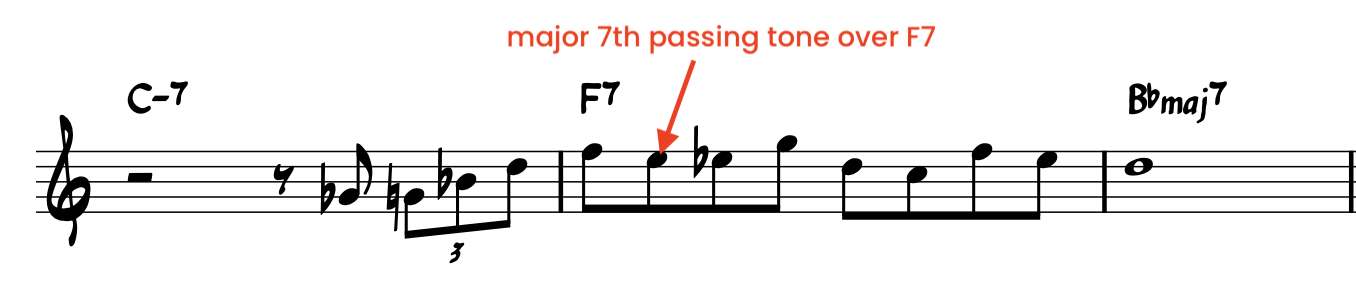
Chord tone targeting is in many ways related to bebop scales, and also some of the licks that we explore in the course do incorporate bebop scales fragments such as the major 7th passing tone over dominant chords, in the following lick for example:

So there are hints of bebop scales in there, but without it becoming an exercise of running scales.

To be honest, bebop scales are not a topic that I have truly explored yet, but I will see if I can incorporate it into the course.

You’ll see in my lesson list above that I’m planning lessons on diminished scale fragments and blues scales, and so perhaps a little bebop scale study will fit nicely there… leave that with me.

If you have any other questions in the interim just let me know, and congrats again on your progress!