So enjoying your lessons! I’m probably missing something here but thought I’d check…
Love those transcriptions!
All the best,
bob
So enjoying your lessons! I’m probably missing something here but thought I’d check…
Love those transcriptions!
All the best,
bob
Hi Bob 
Good question! And thanks for sharing the image of the chord.
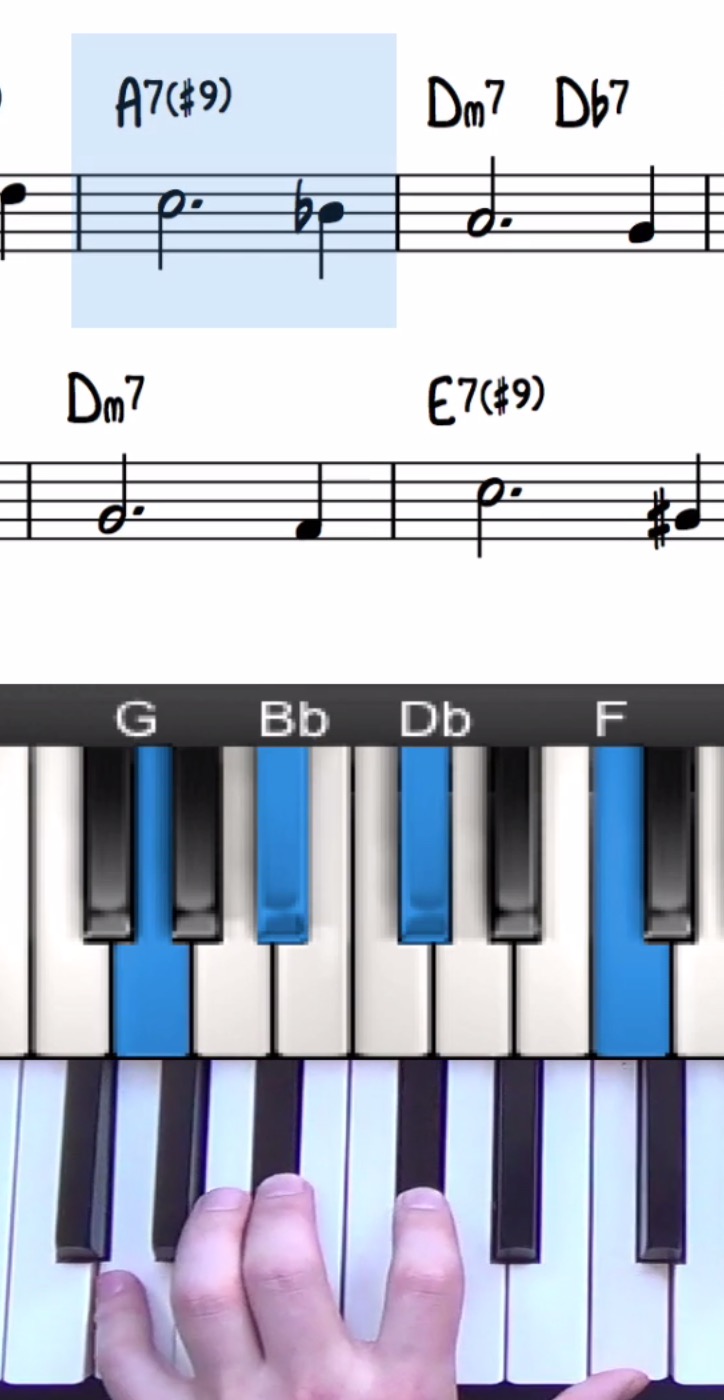
What you are seeing there is a rootless altered chord voicing for A7, my left hand plays the b7(G) b9(Bb) maj3(C#) #5(F) and the #9 (C ) is in the melody.
With altered chords, you have the freedom to include any of the altered tones in your voicings. The lead sheet says A7#9 which indicates that the #9 is in the melody, and you can always add in additional altered tones.
The possible altered tones or ’tensions’ are b9, #9, #11, and #5/b13 (the #5 and the b13 is same note but can be referred to either way).
In that example, I chose to play the b9(Bb) and the #5(F) in my left hand voicing.
You will also see that sometimes I play both the #9 and then the b9 in my voicing, one after another.
If you raise the Bb in your left hand to C Natural, you then have a A7#5#9 voicing (G-C-C#-F), and you can play this for half of the bar, and then drop the C down to Bb to play A7#5b9 (G-Bb-C#-F).
This ‘inner voice’ movement of #9 falling to b9 is a lovely sound. You can play this anywhere in the voicing too which gives you some nice options.
I hope this helps!
Hayden
Hayden, Do you have a lesson(s) on left hand chords with alterations for complex sounds while improvising? I know all the rootless chords, etc, but I am trying to develop a vocabulary of alterations in my left hand… Not two hand voicings. Also, I’d like to see a system for developing my own left hand voicings - improving on what I already am doing… I know about the 3rd / 7th, but including the other chord tones, extensions and alterations is something I’d like to improve in… Thanks Keith
Hi @keith908715
Yes for the theory aspect, I’d recommend to check out the following lesson which covers minor 251s with left hand voicings and different alteration combinations:
Here we talk about the specific movement from the ii-7b5 chord to the altered V7 chord. The movements in this lesson are ‘bread and butter’ minor 251s with rootless voicings.
If you’re already comfortable with the minor 251 variations above, here’s another lesson which goes into more detail on the -11b5 rootless voicing, and how that shape can be inverted to create ‘crunchier’ left hand voicings:
I use that rootless -11b5 voicing a lot as you will see in the seminars listed below on “Beautiful Love” and “Georgia” below.
Technically it’s not a rootless voicings as we play Root-11-b5-7 of the ii-7b5 chord, but also in the first lesson link above, you will see that with minor 251s, we most often include the root in the ii-7b5 chord but play the chord in its 1st or 3rd inversion.
Here’s a lesson where we apply these voicing to “Autumn Leaves”:
Here are 3 seminars where we apply these voicings to 3 different jazz standards:
The “Beautiful Love” and “Georgia On My Mind” seminars have PDFs in the resources section where I have notated these voicings.
Here is the “Georgia” PDF which I think you will find especially useful as I specifically notated the different rootless alteration variations:
If you watch the seminar above you will see me playing all of these variations with the backing track and whilst playing melody in my right hand too.
Is this the kind of sound you are looking for?