Hello @malcolm1 and @Hayden, inversions are something that I finally realised were crucial to my playing and writing  One of the things I do is decide on a " key of the day" and practice all the inversions for all the 7th chords, as well as Type A and Type B major and minor 251 chords. Inversions really " open up" the sound for me. So thanks Hayden for encouraging us to practice this important skill. Cheers
2 Likes
@natasha0412 I love the idea of focusing on a key for multiple exercises. I have time for two keys, so I am going to do a key and its tritone. Thanks for sharing!
2 Likes
Just a higher-level strategic comment:
Yes, you want to minimize wasted time in your practice by identifying things that might be redundant.
But if any exercise related to arpeggios or inversions is not easy for you, it is not a waste of time for you, so it’s OK to include it in your practice with the confidence that it will help your practical skills and technique.
So if you get good at one exercise and then you wonder whether maybe that means you don’t need to bother with some other exercise, just try the other exercise. If you instantly ace it, great! You’re done. If you stumble a bit with the second one, though, it just means you have more to work on, and it’s probably the case that the two exercises are both valuable and they aren’t completely interchangeable from a skills-development perspective.
The only thing that’s a waste of time is too much repetition of things you already do well.
1 Like
I have a pretty firm grasp on inversions and can play them all (maj/min triads) fairly well. It’s really the arpeggios that have been a pain lol. I I just thought maybe I could condense it all down to one particular exercise, but I’ve decided to just practice it all 
Thank you for your input! I’ve been working my way through my arpeggios like that(slightly different). I just group a couple of keys together and drill my arpeggios. Thank you!
FYI
On a side note related to arpeggios: I recently came across McFarren’s The Comprehensive Scale and Arpeggio Manual in a reading service that I subscribe to. It really is comprehensive, with arpeggios with fingering for just about everything from diatonic and chromatic scales, and common and dominant 7th chords, to all manner of interval exercises.
There are quite a few books like it I suppose, but this one seems like it would be a good reference source. 
3 Likes
I’ll definitely check it out! I have Hannon too. Haven’t read it much but I plan to.
Hello @Hayden and @malcolm1 and @scott1. I practice chord inversions of all the 7th chords regularly, but even though it’s fine as a practice drill, when I try to apply them to playing my songs, or the jazz standards I’m working on – it all seems to fall apart and I’m back in root position as a kind of " default" setting. It feels like my hands and brain can’t quite work together quickly enough. If I try to write them out the score, then it feels like I’m learning them, rather than being able to land on an inversion quickly. Do you have any suggestions ? Thanks in advance 
Thanks Hayden, for the info and Malcolm for raising the topic. Am a beginner myself and have been practicing scales, triads and 7th chords and it’s hard as on every change I have to work out the sharps and flats and get the 1, 3, 5 & 7 notes right. I guess repetition is the only path to instant visualization. I had only covered the Jazz Foundations course but seeing Hayden’s response will now work on Extended Chord Voicings.
Thank you!
2 Likes
Hi @natasha0412 
My main suggestion would be to play more songs, and also dedicate more of your practice time to playing tunes.
It sounds like you have absorbed the theory, and you are able to visualise the voicing shapes in isolation, but when you come to apply this to tunes, the fluidity isn’t there. The only way I see that improving is by dedicating more of your practice time to playing tunes.
Understand that being in root position is natural when playing solo piano. By playing the root we are establishing the basis of the harmony. We can then use inversions and rootless voicings to create more interesting sounds above that root note, or perhaps occasionally omit the root note completely.
So don’t view being in root position as a ‘bad thing’, particularly when playing solo piano.
Here is an exercises that I would recommend for you Natasha:
Stride Exercise With Rootless Voicings
For every jazz standard you’re working on, play the root way down in the lower registers with your left hand, and then bring up your left hand to play a rootless voicing 3-5-7-9 or 7-9-3-5 as I demonstrate in these lessons:
- Major & Minor 9th Chords & Progressions | Practice Drills & Exercises
- 251 Progression Drill with 9ths and 13ths | Extended Chords & Voicings Course
Pay attention to the voice leading in 25s and 251s.
At first do this exercise out-of-tempo as it may be difficult to visualise the notes of the voicings and which inversions will be most suitable. As a rough guide, we want to find an inversion as close to middle C as possible.
The end result is to play this exercise in-tempo with a metronome and find those voicing shapes without loosing the pulse.
Aim to complete this flawlessly for at least 10 tunes. Some nice ones to start with could be “Misty”, “Tenderly”, “Over The Rainbow”, & “Body & Soul”. Any slow ballads would work nicely.
By spending 10 minutes per day on that exercise over a few weeks you will definitely feel more confident with rootless voicings and their inversions. Perhaps dedicate half of your practice time to this for the next few weeks.
Initially just start with the left hand. Once you are comfortable with the voicings and keeping to the pulse of the metronome, then add the melody using your right hand.
Some other points for consideration are that the rootless voicings don’t have to be 3-5-7-9 or 7-9-3-5, perhaps try playing just 3rds and 7ths, or adding in some chord extensions/alterations here and there to add more colour and texture.
Play around with that for a few weeks and any other questions just ask 

Hi Arun 
Yes that’s correct, repetition and also a consistent practice schedule are essential.
I do recommend that students study both the Foundations Course, and the Chord Extensions course in tandem as there is a lot of overlap with the theory.
Above anything else, aim to build a repertoire of 20 or so jazz standards.
The end goal is for us to apply the theory in context of any tune we want to play, and sometimes it can be easy to forget that and get lost in all the theory!
Cheers!
Hayden
Thanks Hayden, for your detailed and very useful suggestions.
Natasha
1 Like
My pleasure Natasha.
If you have any further questions with the drill I have outlined just let me know 
Hi Hayden, I have been applying what you suggested and am working on Body and Soul and I Fall in Love Too easily with chord inversions. I do a section at a time in root position, 1st, 2nd and 3rd inversions. That actually makes me think quickly, so it’s quite challenging. My first question is : is there some kind of formula about how many types of inversions to use when playing a song ? Or should I aim for a mixture of all of them ?
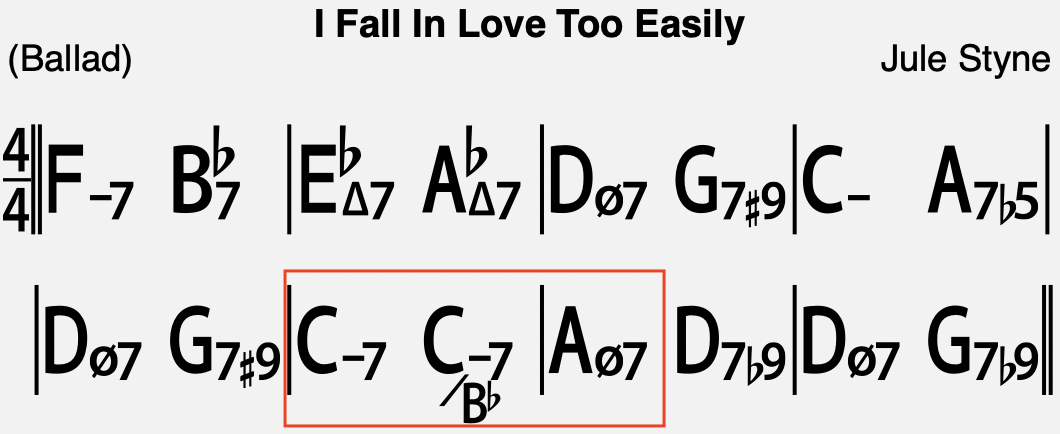
My second question is about the harmonic function of slash chords. In Fall in Love, bar 6, there is a Cm7/Bb chord. What is the function of the Bb, as the melody note is a G ? Thanks for your help. 
Hi Natasha 
Great questions!
I wouldn’t say there is an exact formula or science to this, but I like to add variety to the way I play my voicings, and so yes I would say the latter is what you should aim for.
Try to play a mixture of inversions to get different textures and densities out of the same set of notes. Perhaps sometimes play the root low down and then come up and play a rootless voicings. Perhaps sometimes omit the root completely.
Ultimately, variety is key and we want to use our knowledge of chords and voicings to create a wide range of textures, colours, and tensions when playing jazz piano.
onto your next question:
Slash chords are typically used for 1 of 2 reasons:
- Perhaps the most common reason they are used is to create a specific bass line movement. Using your example of “I Fall in Love Too Easily” see below we have have a bar of C-7 moving to A-7b5 in the next bar. By adding C-7/Bb, it creates a stepwise bass line into the A-7b5 which is pleasing to the ear (C → Bb → A).
Also hearing that C-7 over the Bb in the bass gives the chord a completely different texture. The Bb is a primary chord tone of C-7. When a slash chord has a primary chord tone as the bass note, it’s simply an inversion, but also in this case it is indicating a step wise bass line movement:
- The second reason we use slash chords is to simplify complex chord structures. Think of this as short hand. For example, instead of writing C7#5#9, I can write Ab/C7 which means an Ab triad over C7 in my left hand.
As mentioned above, the function of the Bb in the bass is to imply a specific bass line movement. The chord is still C-7, but over Bb in the bass. The Bb is the b7 of C-7.
The G in the melody is the 5th of C-7, because remember that C-7/Bb is still a C-7 chord, just played in a specific inversion with Bb as the lowest note.
Quite a long explanation there  … I hope it all makes sense and if you would like me to elaborate on anything just let me know
Cheer and stay safe!
Hayden
Hello Hayden and everyone, I have worked out a system for practicing chord inversions in jazz standards, and am working on Misty, Body and Soul, and Days of Wine and Roses this way. I play the scale that each chord is derived from first, and then I work each chord one at time, experimenting with voice leading, observing the melody notes, which tells me which inversion to use. It’s very slow going, but also rather satisfying. I also like to imagine that there is a bass player working with me ( perhaps this might happen one day ? ) . Thanks for your continued inspiration and help. Cheers, Natasha 
Natasha, do you use iRealPro? iRP is my bass player and drummer.
1 Like
Thanks @keynut, I have heard of it, and that it’s very useful. Is it for mobile devices only, or is there a desktop version as well ? Which do you use ?
Thanks, Natasha
Hi Natasha
That sounds like great exercise.
It can be fun to set ourselves little challenges like this.
Something I like to do is set some ‘parameters’ which I must adhere to for the purpose of an exercise, for example, I pick up a tune and the exercise could be:
-
play though all the left hand voicings in a specific inversion, perhaps an inversion that I wouldn’t instinctively play such as the 3rd inversion.
-
try voice all of my chords using some kind of quartal harmony
-
every one of my left hand voicings must contain just 3 notes and also a minor 2nd interval somewhere in the voicing. I particularly like this kind of drill because I discover lots of interesting clusters of notes that I wouldn’t usually consider playing.
Now when I do this this kind of thing, it doesn’t always sound particularly musical - in fact sometimes it’s quite the contrary  - but it forces me to step outside of the normal ‘routes’ I would go down when playing a tune, particularly one that I have played for many years.
It forces me to think on my feet, in the moment, and explore different pathways to where my regular muscle memory would take me.
The fun thing is that we can set any ‘parameters’ we want to make sure it’s a topic that we are comfortable with, or perhaps an area of jazz that we specifically want to work on.
Give it a try and let me know what you think.
Cheers!
Hayden
2 Likes
I have found iRealPro to be super useful, Natasha. I have it on my Android mobile and it’s perfectly fine but if I had a tablet I would probably install it there. I use it all the time-- learning tunes, rootless voicings, progressions practice of all kinds (via the iRP jazz practice folder). Just yesterday, I used it to improvise on the bass lines of all the tunes I’m working on in my ‘active folder’.
1 Like